Frequently Asked Questions
The most-asked questions about arthropods.
What exactly is an arthropod?
Arthropods are invertebrate animals united by three shared traits: a hard chitin-based exoskeleton, jointed appendages, and a body divided into distinct segments. The name itself derives from Greek roots meaning 'jointed foot.'
How many arthropod species are there?
Roughly 1.3 million described species exist, making them by far the largest animal group on Earth. Estimates of total species, including those not yet catalogued, reach into the tens of millions, with insects alone accounting for the overwhelming majority.
What are the main groups within the arthropod 'universe'?
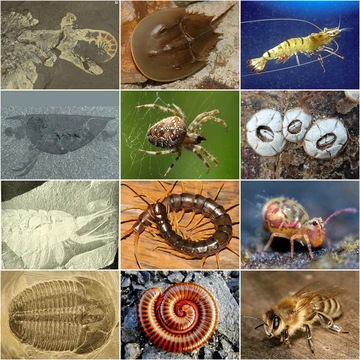
The four major subphyla are Chelicerata (spiders, scorpions, horseshoe crabs), Myriapoda (centipedes, millipedes), Crustacea (crabs, shrimp, barnacles), and Hexapoda (insects and a few lesser-known relatives). Each group has its own body plan, respiratory strategy, and ecological niche.
What's the deal with molting, and why can't they just grow their shell?
The exoskeleton is a rigid, non-living structure that provides protection and muscle attachment but simply cannot stretch. Arthropods therefore shed it in a process called ecdysis, growing a new, larger shell underneath before the old one splits and is discarded.
How many legs do arthropods actually have?
It varies widely by group: insects have six, spiders and scorpions have eight, centipedes and millipedes have dozens to hundreds, and crustaceans range from five pairs to many more. The 'jointed legs' feature is universal, but the count is anything but fixed.
Where do arthropods live?
They occupy virtually every habitat on Earth, from deep-sea hydrothermal vents to high-altitude deserts and narrow freshwater streams. A handful of species have even been carried aboard space stations, though none naturally survive the vacuum of space.
What is the largest arthropod ever recorded?
The Japanese spider crab (Macrocheira kaempferi) holds the record for leg span, reaching up to about 3.7 metres tip to tip. In terms of body mass in a deep-sea setting, the giant isopod (Bathynomus giganteus) is often cited as the heaviest.
How do arthropods breathe?
The method varies by group: insects pump air through an internal network of tubes called tracheae, spiders and scorpions use book lungs or tracheal systems, and most aquatic crustaceans rely on gills. Very small species can simply exchange gases across their thin cuticle without dedicated organs.
When did arthropods first appear, and what's their 'origin story'?
The earliest convincing arthropod fossils date to the Cambrian period, roughly 525 million years ago, with organisms like Anomalocaris showing early arthropod-like features. They have diversified continuously ever since, radiating into more than thirty modern classes.
Why do arthropods matter to the rest of the ecosystem?
They drive pollination, break down dead organic matter, form the base of most terrestrial and aquatic food webs, and keep pest populations in check. Remove them and those ecosystems would begin to collapse within a few seasons.